HelveticMinds AI Control Stack
From Governance to Trusted Autonomy
Control First. Then Autonomy.
The HelveticMinds AI Control Stack is a practical enterprise framework for governing, securing, validating, and scaling artificial intelligence responsibly. It enables organizations to establish clear controls, strengthen human oversight, manage AI-related risks, validate AI systems, and move toward trusted autonomy while maintaining accountability and measurable business value.
AI Adoption Is Accelerating. Governance Must Keep Pace.
Organizations increasingly operate multiple AI initiatives, models, providers, data sources, APIs and autonomous or semi-autonomous systems.
Trusted autonomy does not begin with autonomy. It begins with control.
A Structured Path from Governance to Trusted Autonomy
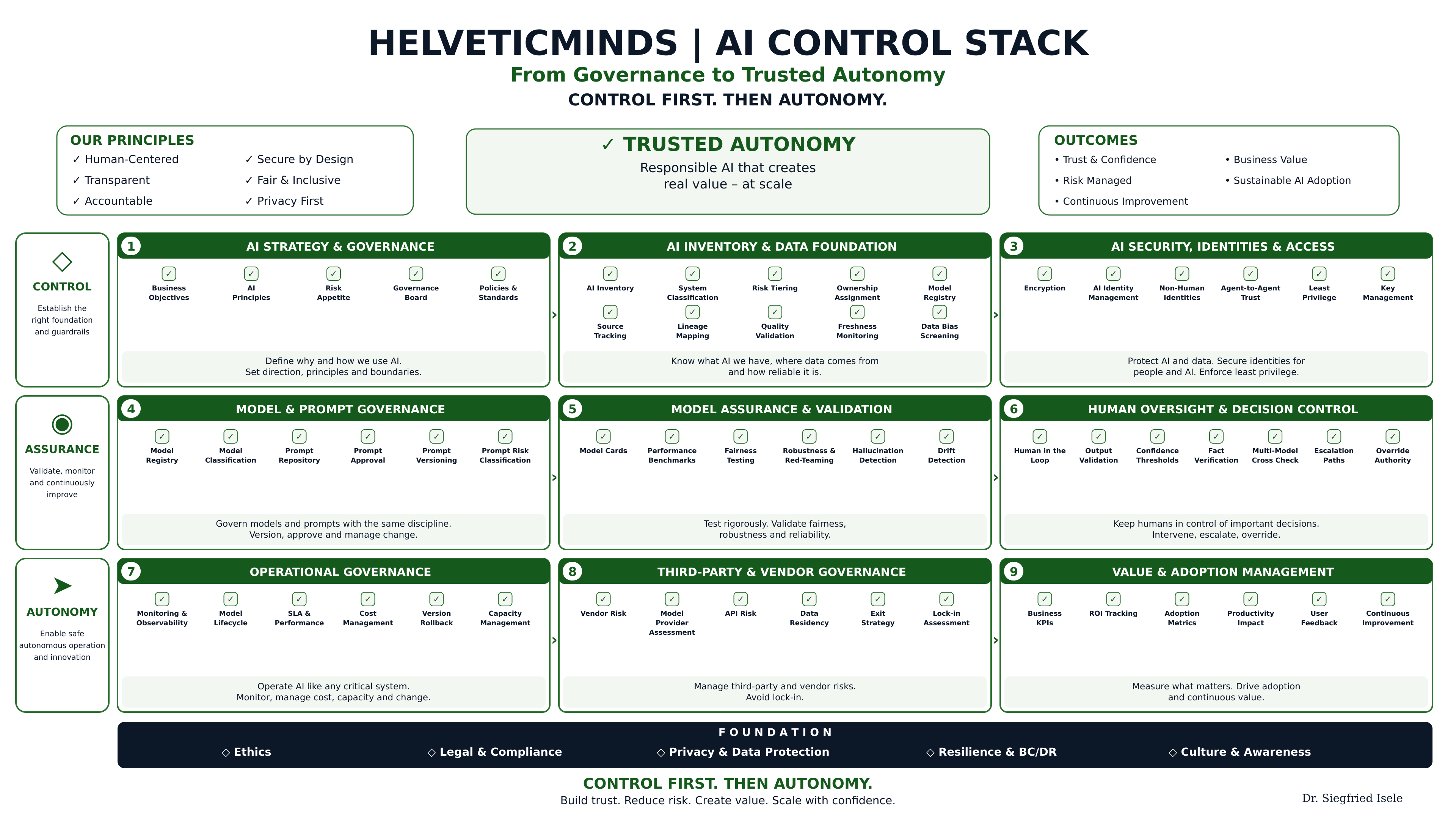
The HelveticMinds AI Control Stack provides a practical structure for establishing and operating enterprise AI governance. It combines nine governance domains, three progressive operating stages, and five cross-cutting foundations to help organizations introduce, manage, validate, and scale AI capabilities with appropriate controls and human accountability. The framework is designed to support real-world implementation, not merely policy documentation or compliance exercises.
How the HelveticMinds AI Control Stack Works
The HelveticMinds AI Control Stack provides a structured view of the capabilities organizations need to govern Artificial Intelligence responsibly as AI becomes more embedded, interconnected and autonomous.
The framework does not assume that every AI use case requires the same level of governance. Controls should be proportionate to business relevance, risk, criticality, data sensitivity and the degree of autonomy involved.
Organizations first need visibility, accountability and clear boundaries.
This includes understanding which AI capabilities exist, why they are used, who is responsible and which governance, security and data foundations are required.
Controls alone are not sufficient.
Organizations also need confidence that AI systems, models, processes and decision mechanisms behave as intended. Assurance therefore focuses on validation, monitoring, oversight and continuous improvement.
Greater AI autonomy should only be enabled when sufficient governance, control and assurance are in place.
The objective is not maximum autonomy. The objective is trusted autonomy: AI that can create value at scale while remaining within defined organizational, technical and human boundaries.
The Nine Governance Domains
The nine domains provide an integrated enterprise view of AI governance — from strategy and data foundations to security, model oversight, assurance, human control, operations, third-party risk and value realization.
Define why and how the organization uses AI. Establish business objectives, AI principles, risk appetite, governance responsibilities, policies, and standards.
Understand which AI systems exist, where the data originates, who owns the systems, and whether the underlying information is reliable. Address AI inventories, classifications, risk tiers, data lineage, quality, and freshness.
Protect AI systems, information, and interactions through appropriate security controls. Address encryption, AI identities, non-human identities, agent-to-agent trust, least privilege, and key management.
Manage models and prompts with structured oversight. Include model classification, prompt repositories, approvals, versioning, and risk classification.
Validate AI systems before and during operational use. Address model cards, performance benchmarks, fairness, robustness, hallucination detection, and drift detection.
Maintain meaningful human accountability. Define human-in-the-loop controls, output validation, confidence thresholds, fact verification, escalation paths, and override authority.
Operate AI systems with appropriate production discipline. Include monitoring, observability, lifecycle management, service levels, performance, cost, rollback, and capacity management.
Manage dependencies and risks associated with external AI technology providers. Address vendor assessments, provider risks, API risks, data residency, exit strategies, and lock-in exposure.
Ensure AI adoption delivers measurable organizational value. Track business KPIs, return on investment, adoption, productivity impact, user feedback, and continuous improvement.
The Foundation
The entire framework rests on five cross-cutting foundations that apply across all nine domains.
These foundations help ensure that AI governance is not treated as a purely technical discipline.
Governance That Enables
The HelveticMinds AI Control Stack is not designed to slow AI innovation.
Its purpose is to create sufficient clarity, confidence and control so that organizations can scale AI responsibly.
Good governance should enable innovation, not block it.
Not every AI system requires the same controls.
But every organization needs to know which controls are appropriate.
Governance Proportionate to Risk.
Not every AI system requires the same level of control.
Governance should reflect business relevance, risk exposure, data sensitivity, operational criticality and degree of autonomy.
The HelveticMinds AI Control Stack supports a proportional, context-sensitive approach rather than one-size-fits-all governance.
Establish the right foundations and guardrails. Organizations define their objectives, governance principles, risk boundaries, AI inventory, security requirements, and responsibilities.
Validate, monitor, and continuously improve. Organizations introduce systematic validation, oversight, performance assurance, escalation mechanisms, and ongoing control effectiveness.
Enable safe autonomous operation and innovation. Organizations introduce greater operational AI autonomy only when the necessary controls, validation mechanisms, monitoring, and accountability structures are established.
"Trusted autonomy must be earned through governance, assurance and operational confidence."
Design Principles
Governance That Enables — Not Governance That Blocks.
Who It Is For
How We Engage
Engagements are tailored to the organization, AI landscape, regulatory environment, risk profile and business objectives.
Intellectual Property
The HelveticMinds AI Control Stack is a proprietary framework developed by Dr. Siegfried Isele and commercialized through Helvetic Minds – SwissShore LLC.
Intellectual property protection measures have been initiated. The current status of any formal registrations or granted rights should be verified with qualified legal counsel.
The framework, structure, terminology, graphical representation and associated methodology may not be reproduced, adapted or commercially used without authorization.
Swiss Governance Thinking. International Perspective.
The HelveticMinds AI Control Stack combines strategy, technology, cybersecurity, governance, risk, human accountability and business value within one integrated approach. Its philosophy is rooted in Swiss precision, responsibility, reliability and controlled execution, while designed for international organizations.